Claude Ship Beta: Automate PR Review, Fixes, and Policy Approvals
How Anthropic's Claude Ship (Code Review, PR Steward, Claude Approvals) works on GitHub, how it differs from CLI /ship, and key limits.
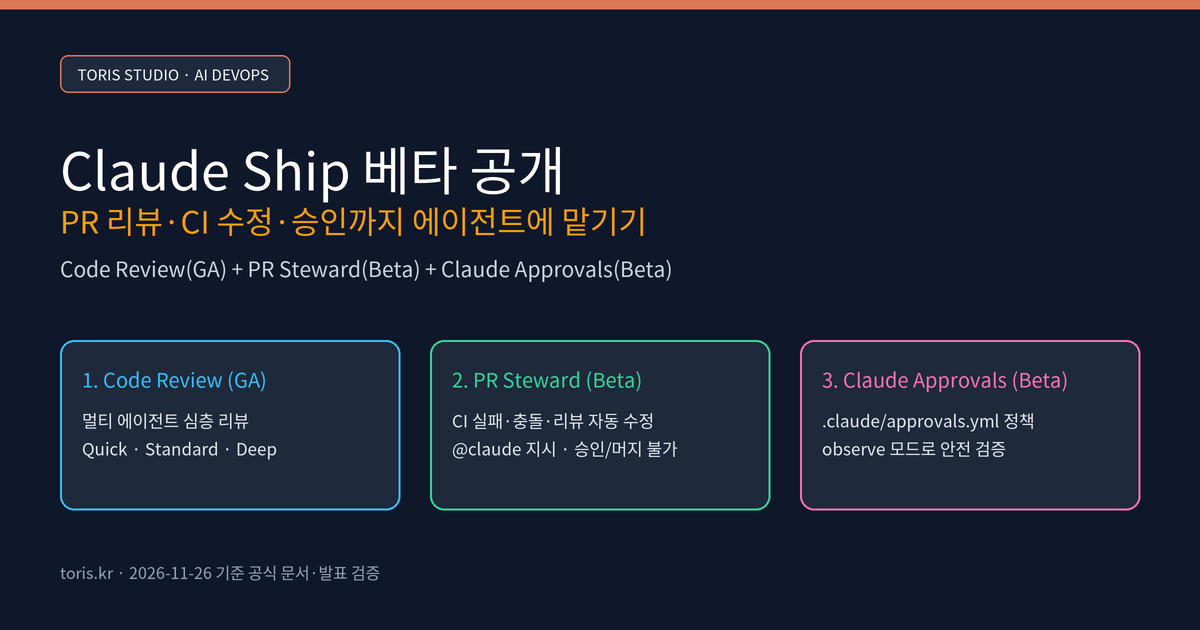
Q. What is Anthropic's Claude Ship, and how does it differ from the
/shipcommand in Claude Code? Claude Ship is an organization-level GitHub workflow that chains three agents after a pull request opens: Code Review (GA), PR Steward (Beta, for fixing failing checks, merge conflicts, and review feedback), and Claude Approvals (Beta, for policy-based approval checks). Unlike the local/shipand/stewardCLI commands that run inside a developer's terminal session, Claude Ship runs in the cloud across enabled repositories on Claude Team and Enterprise plans and bills tokens to the organization.
⚠️ Accuracy guardrail: This post is based solely on Anthropic's official announcement (published November 23, 2026) and the official Claude Code documentation (
/shipandClaude Approvals) verified on November 26, 2026. Because PR Steward and Claude Approvals are in beta, policy keys, promotional credits (at least $10,000 for eligible Claude Enterprise organizations claimed by January 15, 2027), and supported configurations may change.
30-second summary
- Three-agent pipeline: Combines generally available
Code Reviewwith two beta agents—PR Stewardfor fixes andClaude Approvalsfor policy evaluation. - Separation of powers:
PR Stewardpushes fixes for failing CI checks, merge conflicts, and review comments, but is designed never to approve or merge pull requests. - Policy-as-code approvals:
.claude/approvals.ymlon the default branch defines required reviewerseatsand whether Claude may approve; teams can test inobservemode before enforcing branch protection. - Eligibility and exclusions: Available for GitHub repositories on Claude Team and Enterprise plans, excluding organizations with Zero Data Retention (ZDR), HIPAA configurations, or customer-managed encryption keys (CMEK).
Why Claude Ship exists: when PR waiting becomes the bottleneck
Even when coding agents write changes in minutes, developers still lose momentum once a pull request opens—context-switching back to address review comments, chasing broken CI checks, and waiting on human sign-off. Anthropic notes that as Claude began writing most of the code on the Claude Code team, everything after the PR needed to move at the same pace. Between June and September, using Code Review as part of their broader process, the Claude Code team more than doubled merged PRs while cutting the reverted share by over 40%.
This shift aligns with the broader move toward continuous repository automation covered in our GitHub Agentic Workflows GA guide and Claude MCP Skills, Tasks, and Elicitation guide, where agents operate inside explicit repository events and policy guardrails rather than one-off prompts.
The three agents: Code Review, PR Steward, and Claude Approvals
Rather than giving a single agent unrestricted merge authority, Claude Ship splits review, remediation, and approval into distinct roles.
| Component | Status | Core responsibility | Controls & guardrails |
|---|---|---|---|
| Code Review | GA | Deep codebase-aware PR review with categorized findings | Per-repo Quick, Standard, or Deep depth and monthly spend limits |
| PR Steward | Beta | Fixes failing CI checks, merge conflicts, and review feedback | Cannot approve or merge; supports @claude steering and @claude stop |
| Claude Approvals | Beta | Evaluates .claude/approvals.yml and posts approval status or reviews |
Supports observe mode; can require human sign-off on sensitive paths |
Q. Can adding
.claude/approvals.ymlstop automatic Code Reviews? Yes. According to the official documentation, when every file changed in a pull request falls under a policy file, automatic Code Reviews stop unless a matching rule explicitly includesclaude/code_reviewunderadvisory—even inobservemode.
# Example .claude/approvals.yml (from official docs)
version: 1
mode: observe
rules:
  - purpose: "A change takes two people, and Claude doesn't approve."
    paths: ["**"]
    verdict: { claude: comments, seats: 2 }
    advisory: [claude/code_review]
Policy rules can evaluate PR metadata—such as changed line counts, author, and target branch—as well as natural-language classifiers. However, conditions cannot read CI results directly, so CI checks should remain required checks in GitHub branch protection.
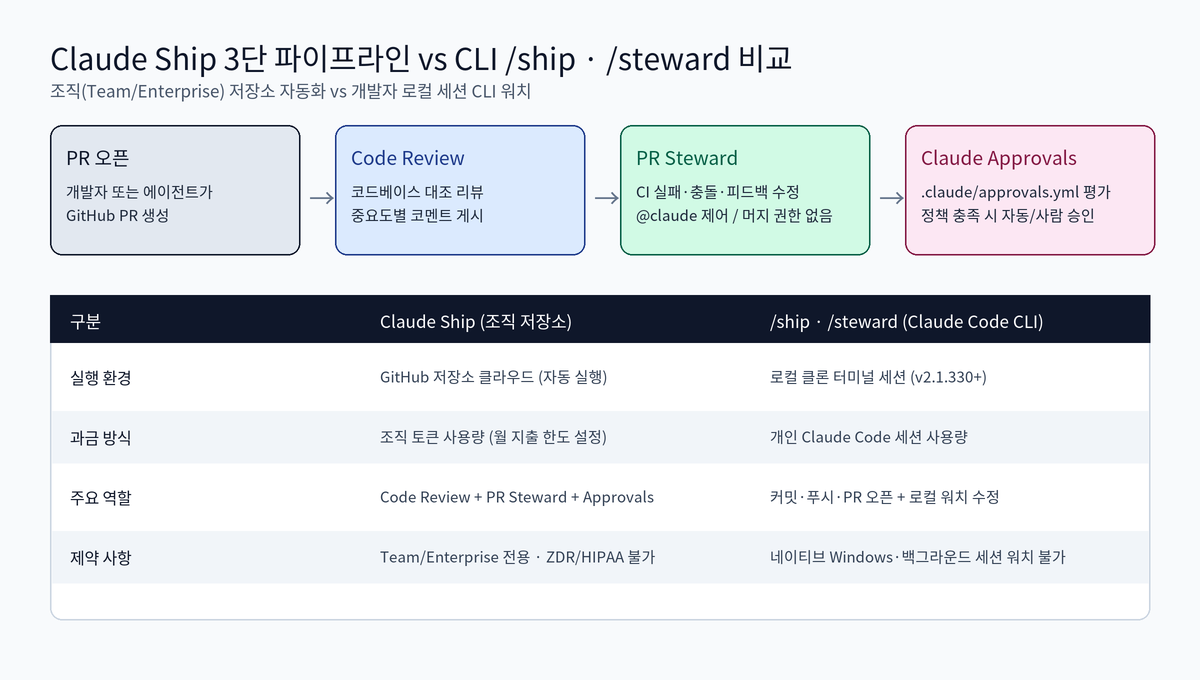
Organization Claude Ship vs. local CLI /ship and /steward
Although the names overlap, Claude Ship (repository-level cloud agents) and /ship / /steward (local Claude Code CLI commands) differ in execution environment and billing.
- Local CLI
/ship(Claude Code v2.1.330+): From a local Git clone,/shipcan commit uncommitted work, push a branch, open a GitHub PR, run/code-review, and start a local "watch" that fixes failing checks and reviewer feedback while your session stays open. Use/stewardto start a watch on an already-open PR without running a review first. - Constraints: Local watches do not start on native Windows or in background sessions, and will not start if organization PR Steward is already active on the PR. Because a watch executes code locally with your credentials, only run it on repositories where you trust everyone who can push to your branch or merge into the base branch.

Pricing model and compliance limits to check first
Claude Ship bills tokens to your organization's Team or Enterprise usage, scaling with PR volume, size, review depth (Quick, Standard, Deep), run frequency, and PR Steward activity. Admins can set monthly spend limits for Code Review and PR Steward. Claude Approvals has no base fee, though classifier runs and policy-triggered Code Reviews are billed on tokens even in observe mode.
Compliance boundaries are strict: organizations with Zero Data Retention (ZDR), HIPAA configuration, or customer-managed encryption keys (CMEK) cannot use Claude Ship, and environments with FERPA or Access Transparency enabled cannot start Claude Approvals.
Toris's take
For solo developers or small teams, start with /ship and /code-review inside your local Claude Code session before enabling organization-wide cloud agents, so you can gauge token usage and workflow fit without extra setup.
For Team and Enterprise engineering orgs handling high PR volume from humans and coding agents alike, roll out one repository at a time: enable Code Review with a monthly spend cap, test PR Steward in manual @claude steward mode, and run Claude Approvals in mode: observe with advisory: [claude/code_review] until its decisions match your human reviewers before making the check required.
Sources
Advertisement