OpenAI GPT-6.2 Astra vs. Sol: Is 1/5-Cost Sol Enough?
Comparing OpenAI GPT-6.2 Astra and Sol API pricing, cache and Ultrafast tiers, official benchmarks, and practical routing rules for developers.
Q. With OpenAI launching GPT-6.2 Astra and GPT-6.2 Sol, which model should solo founders and developers choose in production? For everyday PR reviews, code revisions, and multi-step agent workflows, GPT-6.2 Sol (
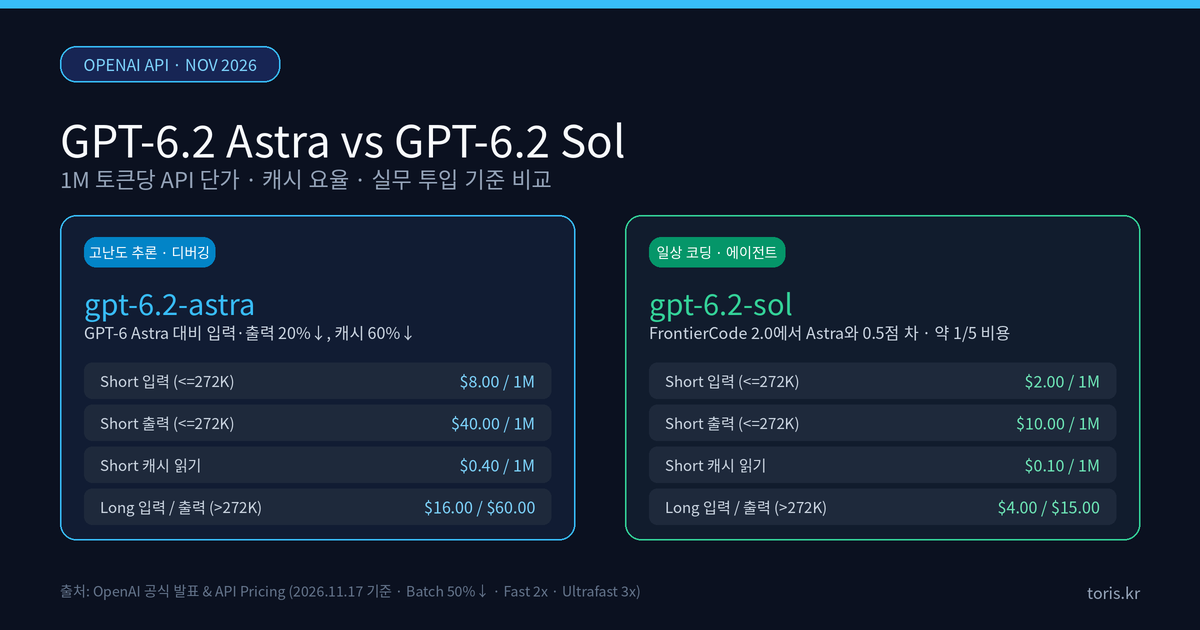
$2 / $10per 1M tokens) should be your default. Reserve GPT-6.2 Astra ($8 / $40) for hard problems—cross-service bug tracing, strict slide or spreadsheet template generation, and demanding legal or scientific reasoning.
⚠️ Accuracy guardrail: This post was written on November 19, 2026, based on OpenAI's official announcement (November 17, 2026), API pricing documentation, and ChatGPT Learn docs. API rates, Ultrafast promotional pricing (3x Standard through February 28, 2027, shifting to 6x on March 1, 2027), and plan availability may change, and this article does not include large-scale internal production benchmarks from Toris Studio.
30-second summary
- Two-tier split: On November 17, 2026, OpenAI introduced GPT-6.2 Astra for complex projects and GPT-6.2 Sol for everyday work.
- Lower Astra pricing:
gpt-6.2-astracuts input and output token prices by 20% compared togpt-6-astra($8 / $40per 1M tokens), with cached input discounted by 60% ($0.40). - Sol efficiency:
gpt-6.2-solkeepsgpt-6.1-sol's API rates ($2 / $10, cached$0.10) while coming within 0.5 points of Astra on Cognition's FrontierCode 2.0 at roughly one-fifth the cost. - Codex and Responses API: You can append a
configuration_updateitem between turns to change reasoning effort or switch to structured output without breaking prompt caching.
Why OpenAI split GPT-6.2 into Astra and Sol
Running a top-tier frontier model on every turn makes multi-step agent loops expensive, so OpenAI separated deep reasoning from everyday execution. Both gpt-6.2-astra and gpt-6.2-sol rolled out simultaneously across ChatGPT Work, Codex, and the API.
Both models are tuned to complete demanding tasks with fewer output tokens. On OpenAI's internal GDPval v2 benchmark, GPT-6.2 Astra scored 6.2 percentage points higher than GPT-6 Astra while using 22% fewer output tokens.
API pricing and context-tier breakdown
gpt-6.2-astra is 20% cheaper than gpt-6-astra ($10 / $50), while gpt-6.2-sol retains gpt-6.1-sol's exact token rates ($2 / $10). Requests exceeding 272K input tokens move to Long context pricing (2x input/cache, 1.5x output).
| Metric (USD per 1M tokens) | gpt-6.2-astra (Short ≤272K) | gpt-6.2-sol (Short ≤272K) | gpt-6.2-astra (Long >272K) | gpt-6.2-sol (Long >272K) |
|---|---|---|---|---|
| Input | $8.00 | $2.00 | $16.00 | $4.00 |
| Output | $40.00 | $10.00 | $60.00 | $15.00 |
| Cached Input | $0.40 | $0.10 | $0.80 | $0.20 |
| Cache Write (30m / 12h) | $10.00 / $20.00 | $2.50 / $5.00 | $20.00 / $40.00 | $5.00 / $10.00 |
| Batch (50% off) | $4.00 / $20.00 | $1.00 / $5.00 | $8.00 / $30.00 | $2.00 / $7.50 |
Speed tiers are also clearly priced. Fast mode runs at 2x Standard, while Ultrafast is priced at 3x Standard through February 28, 2027 (Astra $24 / $120, Sol $6 / $30) before moving to its 6x list rate on March 1, 2027. Note that Ultrafast currently supports US data residency only, so EU-resident workloads must stay on Standard, Fast, or Batch.
Q. How does Sol compare to GPT-6.1 Sol or budget coding alternatives? At identical token prices to
gpt-6.1-sol,gpt-6.2-soldelivers higher intelligence and better multi-step reliability, making it a drop-in upgrade. For a look at lower-cost coding options, see our earlier breakdown on MAI Code 2 and Flash pricing benchmarks.
Official benchmark comparison
Based on OpenAI's November 17 release data, Sol closes most of the gap on real-world coding at a fraction of the cost, whereas Astra dominates long-horizon professional and scientific tasks.
| Benchmark / Domain | GPT-6.2 Astra | GPT-6.2 Sol | Notes (from official release) |
|---|---|---|---|
| Agents' Last Exam | +5.2 pts vs GPT-6 Astra | - | <1/3 cost of GPT-6 Astra; +5.5 pts vs Claude Fable 5.2 at 5% cost |
| Terminal-Bench-Science 0.1 | +9%p vs GPT-6 Astra | - | <1/3 cost of GPT-6 Astra |
| Cognition FrontierCode 2.0 | Baseline (Max) | Within 0.5 pts of Astra | Sol at roughly 1/5 the cost (both at max) |
| GDPval v2 | +6.2%p vs GPT-6 Astra | +5.3 pts vs GPT-6.1 Sol | Astra uses 22% fewer output tokens |
| Harvey LAB-AA v1.1 (Legal) | >2x pass rate vs Claude Fable 5.2 | - | ~1/6 the cost (strict zero-hallucination grading) |
Practical tips for Codex and the Responses API
In the Codex app or CLI (/model), OpenAI recommends using Astra to trace bugs across multiple services and verify affected tests, while delegating pull-request reviews and feedback-driven edits to Sol.
In the Responses API, you can append a configuration_update item before the next user message to adjust reasoning effort or toggle structured output mid-conversation. Keeping earlier request-level settings and prompt prefixes unchanged preserves both cross-turn reasoning and prompt-cache eligibility. As shown in our Caveman token-compression audit, prefix caching often matters just as much as headline token rates.
Toris's take
For solo builders running multiple products and automated agents, the most practical setup is routing all default coding and workflow tasks to gpt-6.2-sol and escalating to gpt-6.2-astra only when a multi-service bug or strict deliverable fails. With cached input now down to $0.10/1M on Sol and $0.40/1M on Astra, locking your system prompts and tool definitions at the front of every request will yield immediate cost savings.
Sources
Advertisement