BitNet (bitnet.cpp): Running 1-Bit LLMs on CPUs Without a GPU
How microsoft/BitNet achieves up to 6.17x CPU speedup and 82.2% energy savings, plus 2026 embedding models, VibeASR.cpp, setup steps, and key limits.
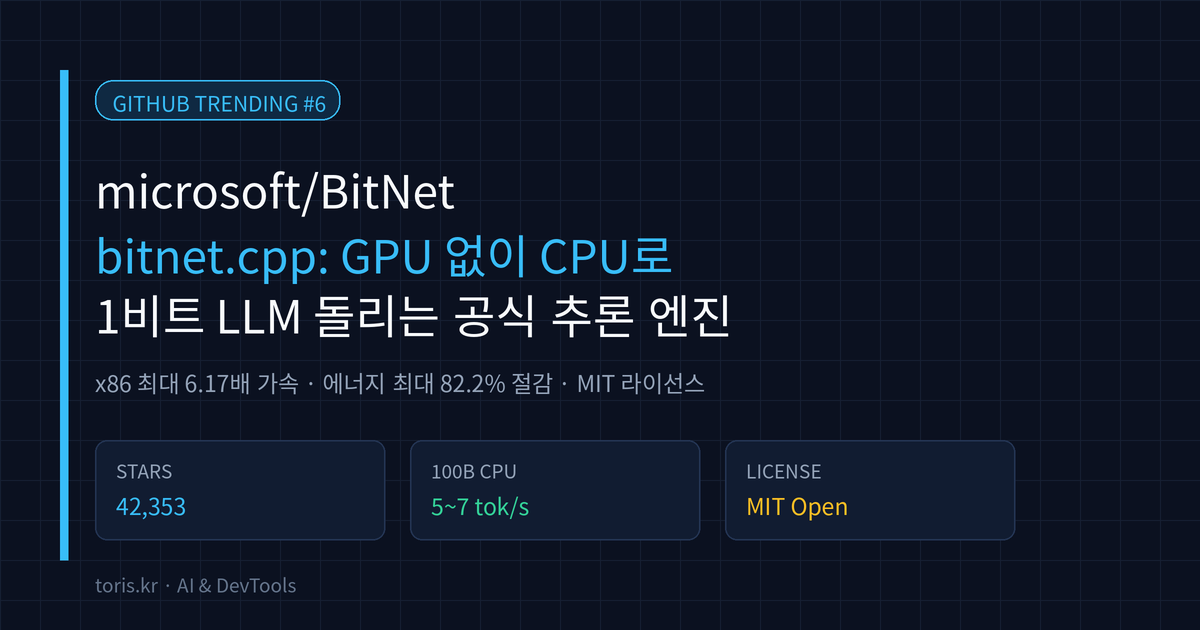
Q. Can you run Large Language Models (LLMs) at a usable speed on CPUs alone without an expensive GPU? Yes. With bitnet.cpp (
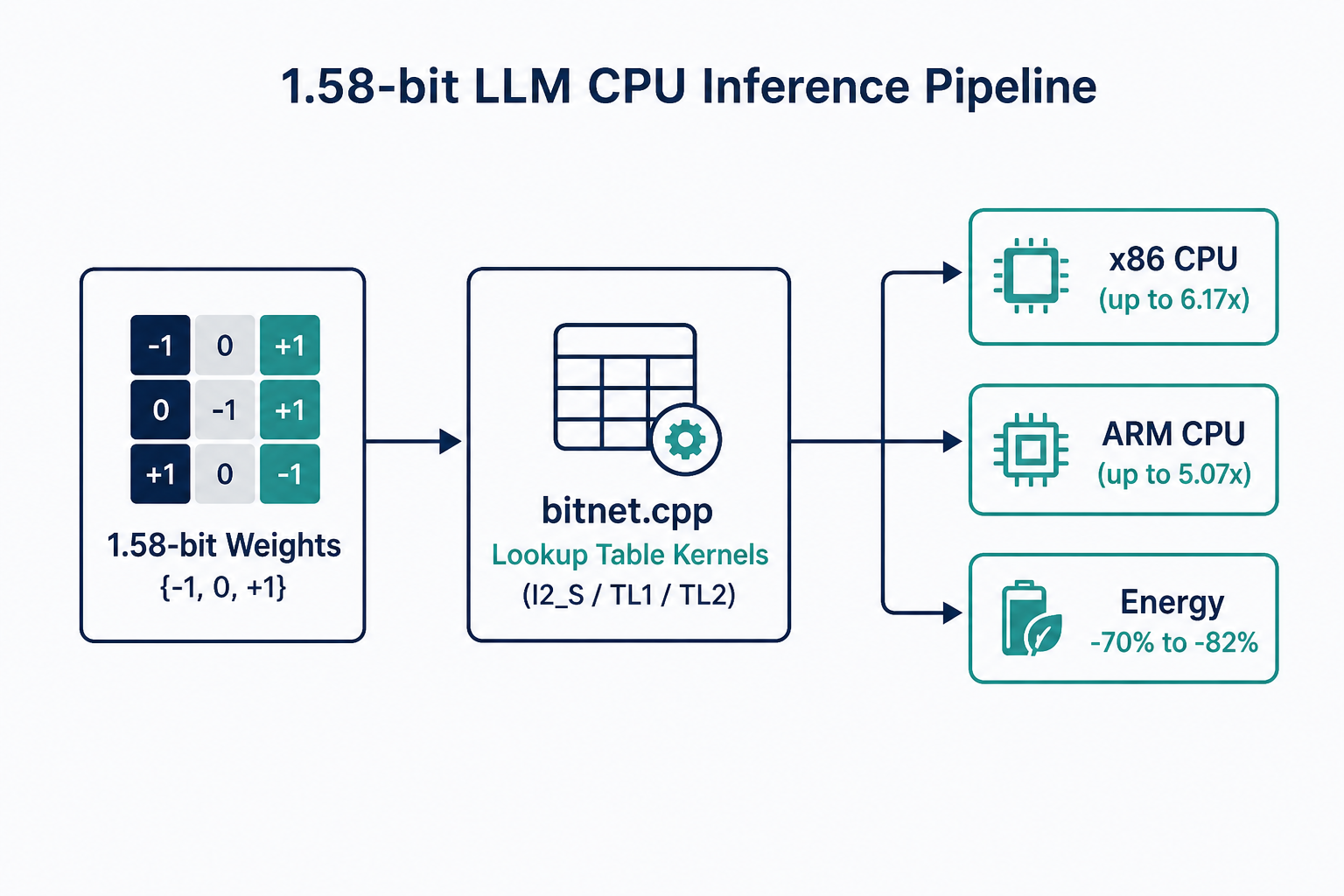
microsoft/BitNet), Microsoft's official inference framework for 1-bit LLMs, you can run lossless 1.58-bit ternary models ({-1, 0, +1}) directly on CPUs. According to the official repository benchmarks, it achieves up to 6.17x speedup on x86 CPUs and 5.07x on ARM CPUs, and can even run a 100B parameter BitNet b1.58 model on a single CPU at 5–7 tokens per second (comparable to human reading speed).
⚠️ Accuracy guardrail: This guide is verified directly against the official
microsoft/BitNetGitHub repository (42,353 Stars, 3,995 Forks, MIT license) and API metadata as of November 21, 2026. Actual tokens-per-second in local environments vary by CPU generation, memory bandwidth, and thread count; the latest commit onmain(0b341e5) is dated July 27, 2026.
30-second summary
- Core idea: Built on
llama.cppandT-MAClookup-table kernels,bitnet.cppexecutes 1.58-bit ternary LLMs, embedding models, and speech models efficiently on CPUs and GPUs. - Verified gains: Delivers 2.37x–6.17x speedup with 71.9%–82.2% energy reduction on x86 CPUs, and 1.37x–5.07x speedup with 55.4%–70.0% energy reduction on ARM CPUs compared to full-precision models.
- 2026 ecosystem expansion: Beyond
BitNet-b1.58-2B-4T(2.4B), Microsoft has released 1-bit CPU embedding models (BitNet-embedding-0.6B/270M) andVibeASR.cppfor real-time multilingual speech recognition. - Best fit: Solo developers cutting GPU server bills, offline laptop/edge AI setups, and local RAG pipelines.
1. Why bitnet.cpp differs from standard quantization
1.58-bit ternary models constrain weights to {-1, 0, +1} during training rather than compressing an existing model afterward. Standard 4-bit or 8-bit post-training quantization shrinks a 16-bit model after training, which degrades accuracy as bit width drops. BitNet b1.58 replaces expensive floating-point matrix multiplications with simple integer additions and subtractions, dramatically improving CPU cache efficiency.
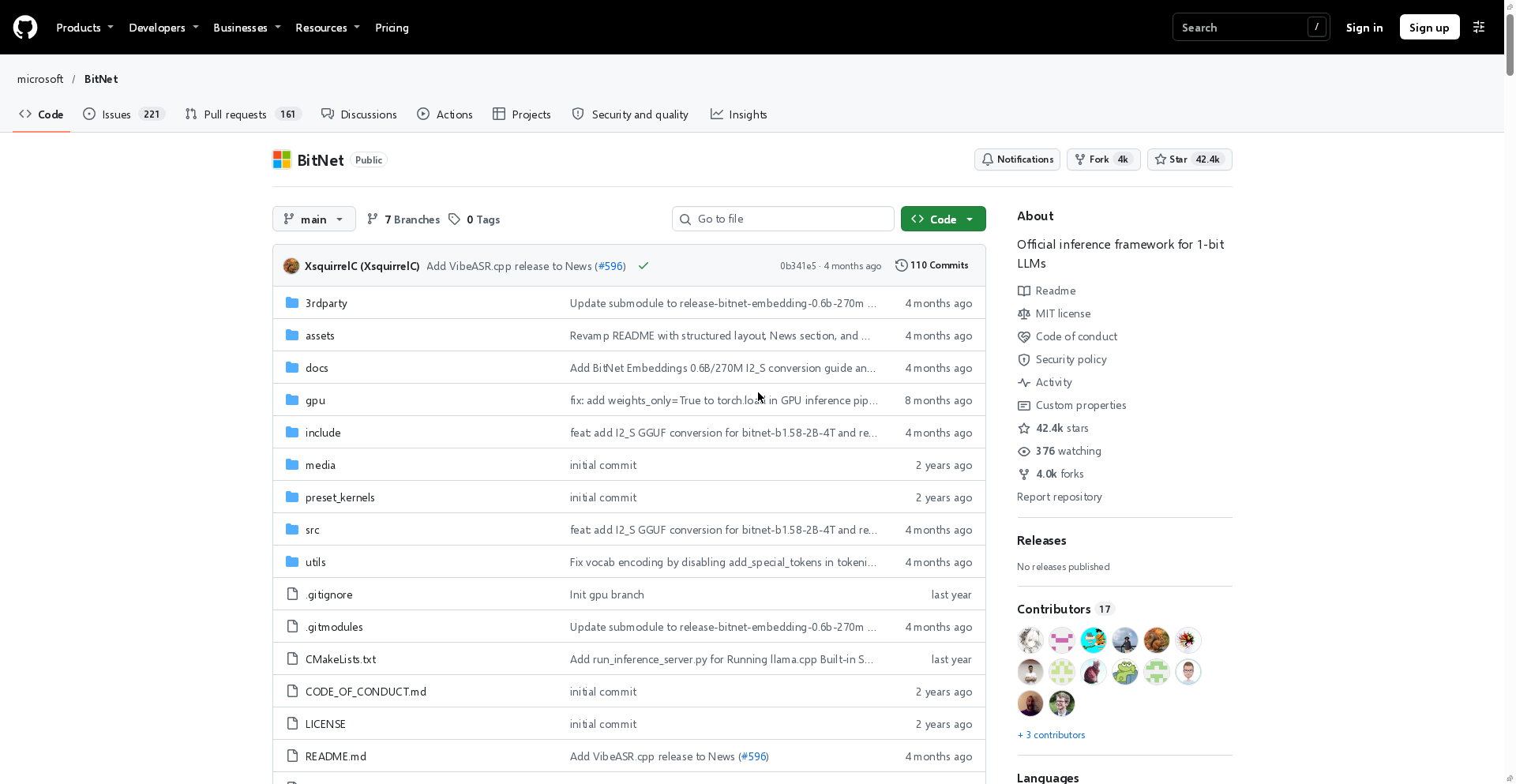
To translate this math into real hardware speed, bitnet.cpp ships specialized lookup-table kernels (I2_S, TL1, and TL2). As of November 21, 2026, the repository holds 42,353 Stars and 3,995 Forks under the MIT license, written primarily in C++ (48.6%) and Python (48.0%).
2. CPU and ARM speedups and energy savings
Standard laptop and server CPUs reach human-readable generation speeds while slashing power draw. The official repository reports the following benchmark ranges against full-precision baselines:
| Platform | Speedup vs. Full Precision | Energy Reduction | Notes |
|---|---|---|---|
| x86 CPU | 2.37x – 6.17x | 71.9% – 82.2% | Supports I2_S, TL2 kernels |
| ARM CPU | 1.37x – 5.07x | 55.4% – 70.0% | Supports I2_S, TL1 kernels |
| 100B Single CPU | 5–7 tokens/sec | - | Comparable to human reading speed |
In January 2026, Microsoft added parallel CPU inference optimizations with configurable tiling and embedding quantization, yielding an extra 1.15x–2.1x speedup over the original release. An official GPU inference kernel (gpu/ directory) is also available when hardware acceleration is present.
3. Official 2026 models and ecosystem
The 1-bit CPU stack now covers text embeddings and real-time speech recognition alongside LLMs. Supported official and community models include:
| Model | Parameters | Role | Key Highlights |
|---|---|---|---|
BitNet-b1.58-2B-4T |
2.4B | Chat LLM | Trained on 4T tokens, first official 1.58-bit LLM |
BitNet-embedding-0.6B |
0.6B | Text Embedding | 1.42x–2.28x prefill speedup over F16 (8 x86 threads) |
BitNet-embedding-270M |
270M | Compact Embedding | 1.32x–1.74x prefill speedup over F16 (8 x86 threads) |
VibeASR.cpp |
- | Multilingual ASR | Real-time CPU speech recognition with I2_S (RTF < 1) |
| Community Models | 0.7B – 10B |
General / Research | Llama3-8B-1.58, Falcon3 family (1B–10B), and more |
For local RAG and document search, offloading embeddings to CPU without losing accuracy frees valuable GPU VRAM. If you are exploring compact local models, compare this approach with our MiniMind-3 64M From-Scratch Guide and Inkling 2 Mini 26B Looped Model Guide.
4. Building and running inference locally
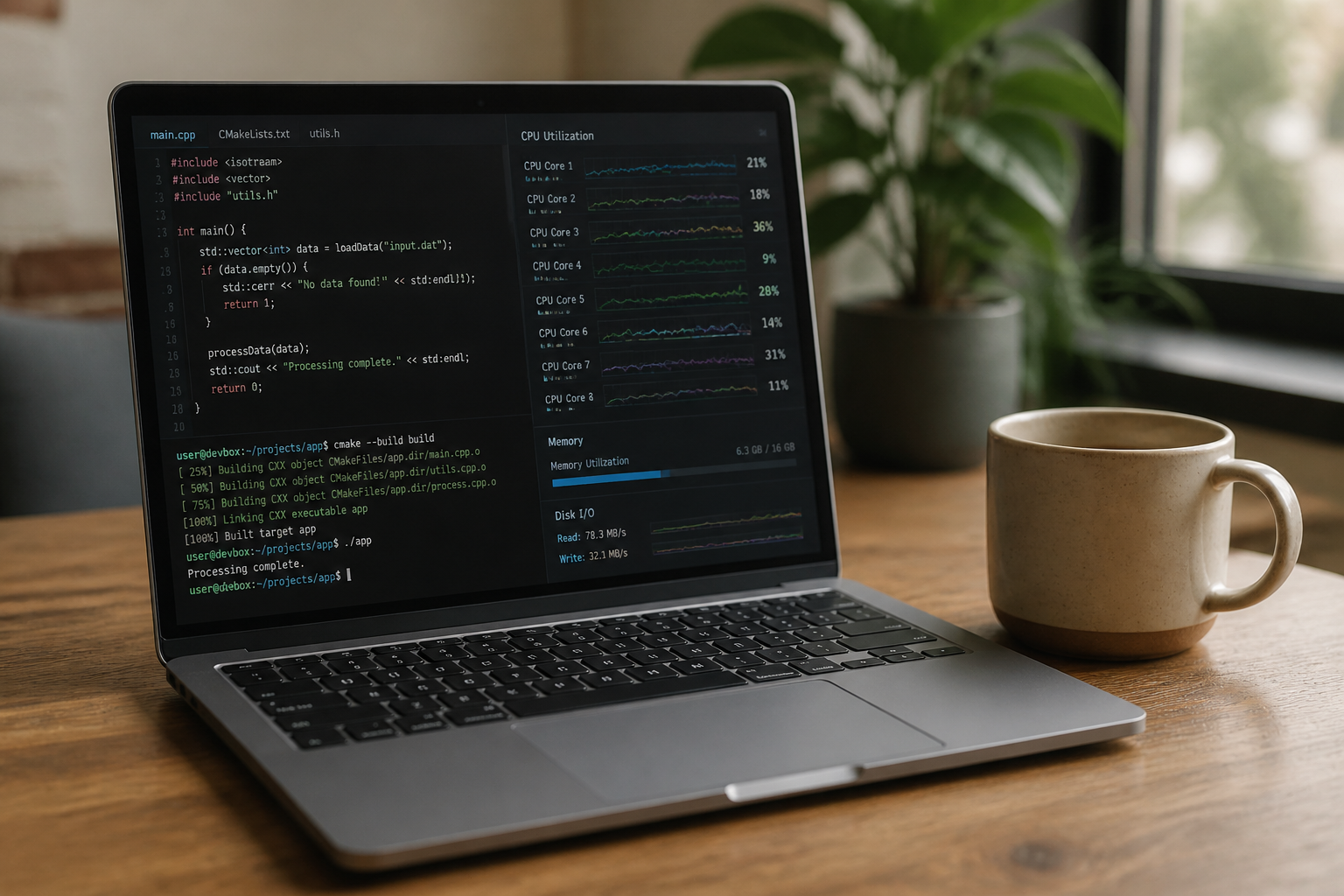
With Python 3.10+, CMake 3.22+, and Clang 18+, you can build from source and start interactive chat inference in minutes. On Windows, install Visual Studio 2022 with C++ Desktop Development, CMake Tools, and Clang, then run commands from a Developer Command Prompt.
# 1. Clone the repository
git clone --recursive https://github.com/microsoft/BitNet.git
cd BitNet

# 2. Install dependencies (conda recommended)
conda create -n bitnet-cpp python=3.10
conda activate bitnet-cpp
pip install -r requirements.txt

# 3. Download the official 2B model and build with I2_S kernel
huggingface-cli download microsoft/BitNet-b1.58-2B-4T-gguf --local-dir models/BitNet-b1.58-2B-4T
python setup_env.py -md models/BitNet-b1.58-2B-4T -q i2_s

# 4. Run interactive chat inference
python run_inference.py -m models/BitNet-b1.58-2B-4T/ggml-model-i2_s.gguf -p "You are a helpful assistant" -cnv
You can also launch run_inference_server.py to expose a llama.cpp built-in HTTP server for local applications.
5. Limitations to check before adopting
Standard FP16/BF16 weights cannot simply be dropped into bitnet.cpp to gain 1-bit speed. Models must be trained as BitNet b1.58 checkpoints or converted into supported I2_S, TL1, or TL2 formats. Additionally, the official support matrix shows that BitNet-embedding-0.6B and 270M currently support x86 I2_S kernels only and do not yet support ARM CPUs—check target architecture compatibility before deploying on Apple Silicon or ARM instances.
Toris's take
- Building CPU-only local AI or RAG backends: If you want near-zero inference cost for embeddings (
BitNet-embedding-0.6B) or lightweight chat (BitNet-b1.58-2B-4T) on x86 servers or laptops without GPUs,bitnet.cppis worth benchmarking right away. - High-stakes reasoning or complex coding: A 2.4B ternary model will not replace flagship cloud models. Use a hybrid setup—keep frontier APIs for complex reasoning, and route offline tasks, high-volume preprocessing, or CPU speech recognition (
VibeASR.cpp) throughbitnet.cpp.
Sources
Advertisement