HeyGen Avatar 6: Inside the '84% Indistinguishable' Claim and Word Edit
Breaking down HeyGen Avatar 6's 84.4% Turing test math, single-clip vs. side-by-side results, 48.3 dB Word Edit preservation, and 30s consent rules.
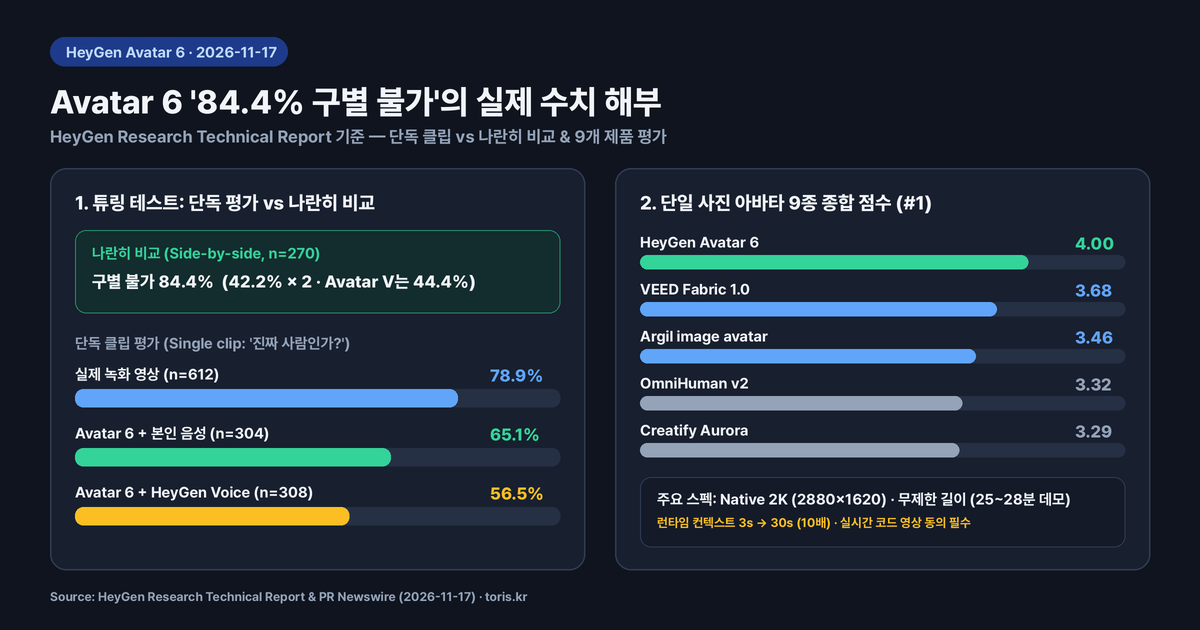
Q. Does HeyGen Avatar 6's "84% indistinguishable from real footage" claim mean viewers couldn't tell it apart from a real video? Not quite in every setting. In a side-by-side test against real footage, raters picked Avatar 6 as the real one 42.2% of the time, and HeyGen doubled that against the 50% coin-flip baseline (2 × 42.2%) to report 84.4% indistinguishability. When clips were shown alone, 65.1% of Avatar 6 clips using the person's own voice and 56.5% using a HeyGen Voice clone were judged real (compared with 78.9% for real recordings).
⚠️ Accuracy guardrail: This post reflects information as of November 20, 2026. All benchmark numbers come from the HeyGen Research technical report, official product pages, and PR Newswire announcement published on November 17, 2026. Per-plan credit burn rates and per-minute API pricing were not disclosed in those materials and are omitted here.
30-second summary
- Core upgrades: Released on November 17, 2026, HeyGen Avatar 6 expands its runtime context window 10× from roughly 3 seconds to 30 seconds for script-matched gestures, renders at Native 2K (2880×1620) per frame, and removes fixed duration caps (demonstrating 25–28 minute continuous generations).
- Behind the 84.4% figure: Across 270 side-by-side comparisons with real footage, 42.2% chose Avatar 6 as real (up from 44.4% indistinguishability for Avatar V). Shown alone, real-judged rates were 65.1% with the speaker's real voice and 56.5% with HeyGen Voice.
- Word Edit preservation: When replacing a single spoken phrase in an existing recording, Avatar 6 keeps untouched regions at 48.3 dB PSNR (versus 29.3 dB for Seedance 2.5), changing only 34.4% of pixels.
- Operational constraints: Creating a realistic avatar of a real person requires a live on-camera consent recording with a one-time code; third-party APIs are restricted to photo-based and virtual avatars.
We also summarized the key takeaways of Avatar 6 in a short video on the Toris Studio YouTube channel.
1. How "84.4% indistinguishable" was actually measured
It means 42.2% of raters picked the AI clip as real in a side-by-side comparison, whereas single-clip realism drops to 56.5%–65.1% depending on voice cloning. The HeyGen Research technical report separates two distinct Turing-style evaluations built from held-out footage of real speakers.
| Evaluation format | Test condition | Judged real | Responses |
|---|---|---|---|
| Single clip (shown alone) | Real recorded footage | 78.9% | 612 |
| Single clip (shown alone) | Avatar 6 + speaker's own voice | 65.1% | 304 |
| Single clip (shown alone) | Avatar 6 + HeyGen Voice clone | 56.5% | 308 |
| Side-by-side (same audio) | Real footage picked as real | 57.8% | 270 |
| Side-by-side (same audio) | Avatar 6 picked as real | 42.2% | 270 |
| Indistinguishability (2 × above) | Avatar V scored 44.4% | 84.4% | 270 |
For solo builders and content teams, the practical takeaway is the voice gap. Even with identical Avatar 6 video rendering, using the speaker's actual voice (65.1%) outperforms a cloned HeyGen Voice (56.5%) by 8.6 percentage points. Upgrading the video model alone does not erase synthetic cues if the audio track still sounds cloned.
Q. How big is the jump from HeyGen Avatar V? Side-by-side indistinguishability jumped by 40.0 percentage points, from 44.4% on Avatar V to 84.4% on Avatar 6. In blind online user votes on identical prompts, Avatar 6 Quality beat Avatar V 69.7% to 23.2% (75.0% of decisive votes).
2. Why gestures look less repetitive: 30s context and Native 2K
Instead of looping recycled poses, Avatar 6 reads a 30-second runtime context window and triggers gestures on spoken cues. According to HeyGen's PR Newswire release, the 10× context expansion (from ~3 seconds to 30 seconds) lets the model count on fingers, point laterally on directional cues, or shift posture to match script tone.
Every frame is generated at Native 2K (2880×1620) without a fixed duration ceiling—the technical report includes continuous 25–28 minute single-track generations with no loop seams. Through HeyGen MCP, developers can also render a two-speaker podcast frame (host and guest) in one pass. From an automation standpoint, pairing MCP-driven video generation with agent workflows like those covered in our Claude Code experimental Code Mode guide makes automated release briefings straightforward.
3. Nine-product photo benchmark and Word Edit performance
External raters ranked Avatar 6 #1 overall across both single-photo (4.00/5) and personal-footage (3.98/5) benchmarks, while Word Edit showed the widest technical lead.
| Product (single photo + speech) | Overall (out of 5) | Visual quality | Identity | Lip sync | Motion naturalness | Avatar 6 win rate |
|---|---|---|---|---|---|---|
| HeyGen Avatar 6 | 4.00 | 4.33 | 4.39 | 4.12 | 4.01 | Baseline |
| VEED Fabric 1.0 | 3.68 | 3.96 | 4.20 | 3.71 | 3.74 | 69.6% |
| Argil image avatar | 3.46 | 3.76 | 4.32 | 3.52 | 3.55 | 80.9% |
| OmniHuman v2 | 3.32 | 3.70 | 3.97 | 3.44 | 3.41 | 80.8% |
| Creatify Aurora | 3.29 | 3.33 | 3.99 | 3.48 | 3.40 | 84.3% |
Against general video models using personal footage references, external raters favored Avatar 6 over Seedance 2.5 (72.4%), Wan 3.0 (74.1%), and Kling 4.0 reference-to-video (54.9%). On single-photo input alone, however, Avatar 6 effectively tied Wan 3.0 at a 50.1% win rate (−0.01 overall delta). General video generators are already competitive from a single still image; Avatar 6's clearest advantage appears when driven by a person's own footage.
For product teams, Word Edit is arguably the standout feature. When changing "made a pizza" to "made a lasagna" inside an existing clip, competing models re-rendered the entire frame (19.5–29.3 dB untouched PSNR, 99.7%–100% frames changed), whereas Avatar 6 preserved 48.3 dB PSNR outside the edited words with only 34.4% frame change. That allows teams to patch an outdated price, date, or feature name without re-shooting.
4. Consent verification and 30-second onboarding rules
Creating a personal avatar from real footage requires at least 30 seconds of video plus a live on-camera consent statement reciting a one-time session code. Pre-recorded clips or third-party footage cannot pass the liveness check, and rendering stays locked until identity verification matches the training footage.
While third-party integrations and APIs can generate photo-based and synthetic avatars, realistic avatars of real people remain confined to HeyGen's own platform where explicit consent is enforced. Existing Personal Avatar users are upgraded to Avatar 6 automatically without re-recording.
Toris's take
For solo studios maintaining product walkthroughs, multilingual demos, or frequent SaaS updates, Avatar 6 delivers practical time savings. Word Edit's 48.3 dB background preservation and 30-second gesture context directly cut re-shoot overhead.
- Record your own voice when possible: For founder-led demos and YouTube explainers, pairing Avatar 6 with your own mic recording (65.1% judged real) avoids the subtle uncanny gap still present in cloned voices (56.5%).
- Upload 30+ seconds of footage instead of one photo: From a single photo, Avatar 6 ties Wan 3.0 (50.1%); its clear margin emerges when personalized from real video.
- Wire it into release workflows: Combining HeyGen MCP two-speaker rendering with automated changelog pipelines fits studio setups like our Toris Studio services workflow.
Sources
Advertisement