OpenSRE: Open-Source Agent That Triages Red CI Builds and Opens PR Fixes
How Tracer-Cloud/opensre correlates CI logs, commits, and Grafana/Datadog telemetry to separate CI vs. code failures and push PR fixes for review.
Q. Can an open-source agent diagnose broken CI/CD builds from logs and open a PR fix for review? Yes. OpenSRE (
Tracer-Cloud/opensre) is an Apache-2.0 open-source CLI and self-hosted agent that inspects failed CI runs, recent commits, and observability data from Grafana or Datadog to separate CI-caused issues from code regressions and push proposed fixes to a PR branch.
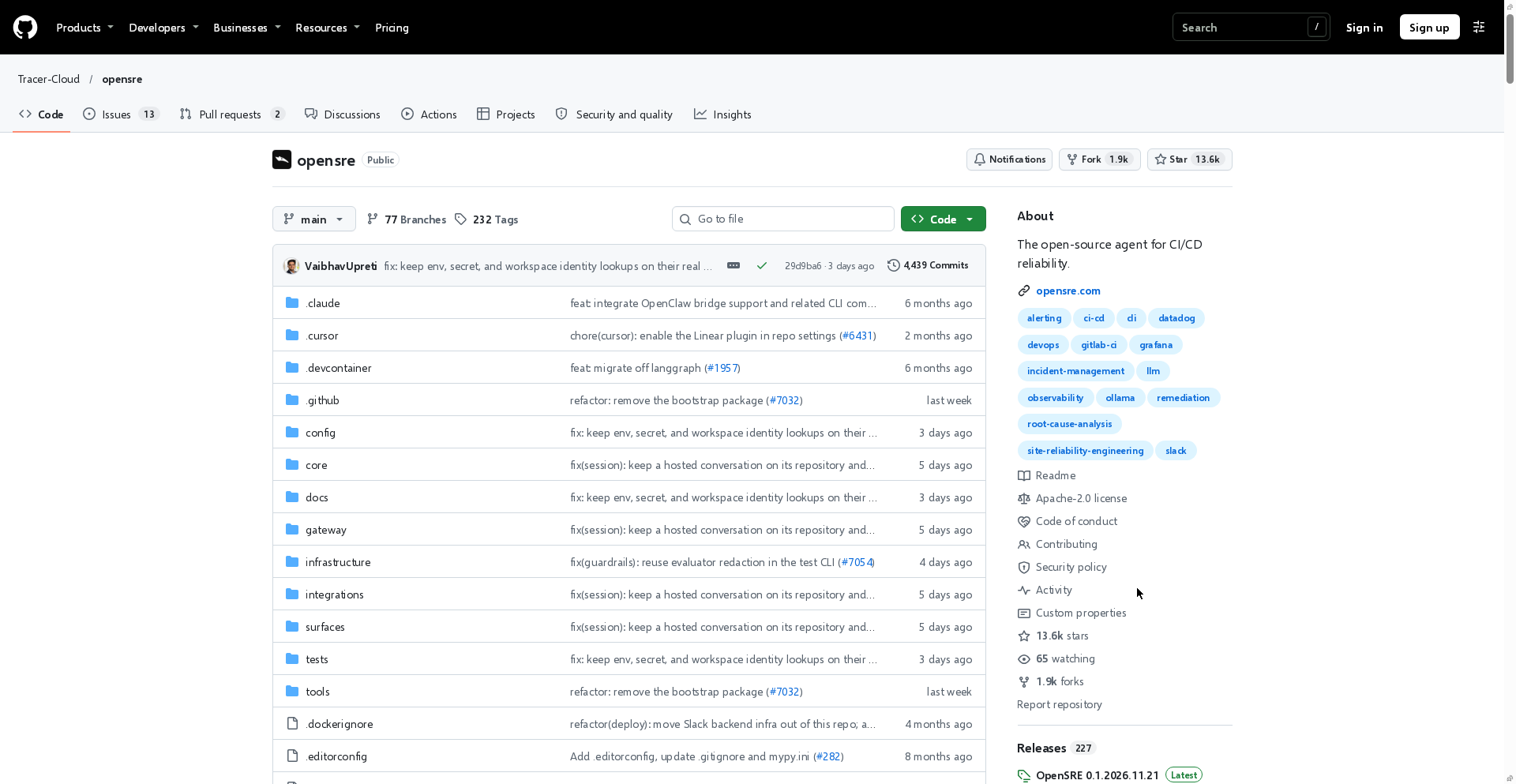
⚠️ Accuracy guardrail: All repository facts in this post were verified on November 21, 2026 against the official GitHub repository (
Tracer-Cloud/opensre, 13,625 stars, 1,926 forks, latest releasev0.1.2026.11.21) and its README. Because the project is in Public Alpha, APIs and integrations may change, and proprietary OpenSRE Cloud pricing or third-party production benchmarks are not published in the repo.
30-second summary
- Built specifically for CI/CD reliability: Instead of blind re-runs, OpenSRE correlates failing CI logs with recent commits and telemetry to distinguish CI infrastructure failures from code-caused bugs and pushes a fix for review.
- 60+ integrations & self-hosted models: Connects to GitHub, GitLab, Jenkins, Grafana, Datadog, Sentry, Kubernetes, Slack, and Telegram, running on your own infrastructure with Anthropic, OpenAI, Gemini, Ollama, or Bedrock.
- Watchouts before adopting: Licensed under Apache-2.0, but currently Public Alpha. First-party analytics and Sentry telemetry are opt-out by default, so set
export OPENSRE_NO_TELEMETRY=1before running in sensitive environments.
This project ranked #3 in our November 20 GitHub Trending roundup on the Toris Studio YouTube channel. AI coding tools keep accelerating how fast we generate commits, yet tracking down why a CI pipeline turned red still eats up hours of engineering time. Here is how OpenSRE approaches the problem and where it fits today.
The problem OpenSRE targets: root-cause separation over blind re-runs
The real cost of a red build is not the failure itself—it is the habit of hitting re-run and hoping it passes.
Standard CI alerts tell you that a job failed, not whether the culprit is a flaky runner, a dependency outage, or a real code regression. OpenSRE starts investigating as soon as a check fails or an engineer asks a question, testing hypotheses across logs and commit history.
| Area | Traditional CI + Manual Triage | OpenSRE Agent Workflow |
|---|---|---|
| Failure diagnosis | Engineers manually cross-check logs, diffs, and dashboards | Automatically correlates failed checks, commits, and observability logs |
| Cause classification | Relies on senior engineer context | Separates CI-caused vs. code-caused failures via tool-calling loop |
| Remediation | Local reproduction and manual patch commit | Generates a fix and pushes to the PR branch for human review |
| Reporting | Raw failure link notification | Posts evidence-backed summary to Slack, PagerDuty, or Telegram |
Six-step architecture and 60+ integrations
OpenSRE drops heavy graph/chain abstractions in favor of a direct tool-calling loop across code, observability, and incident channels.
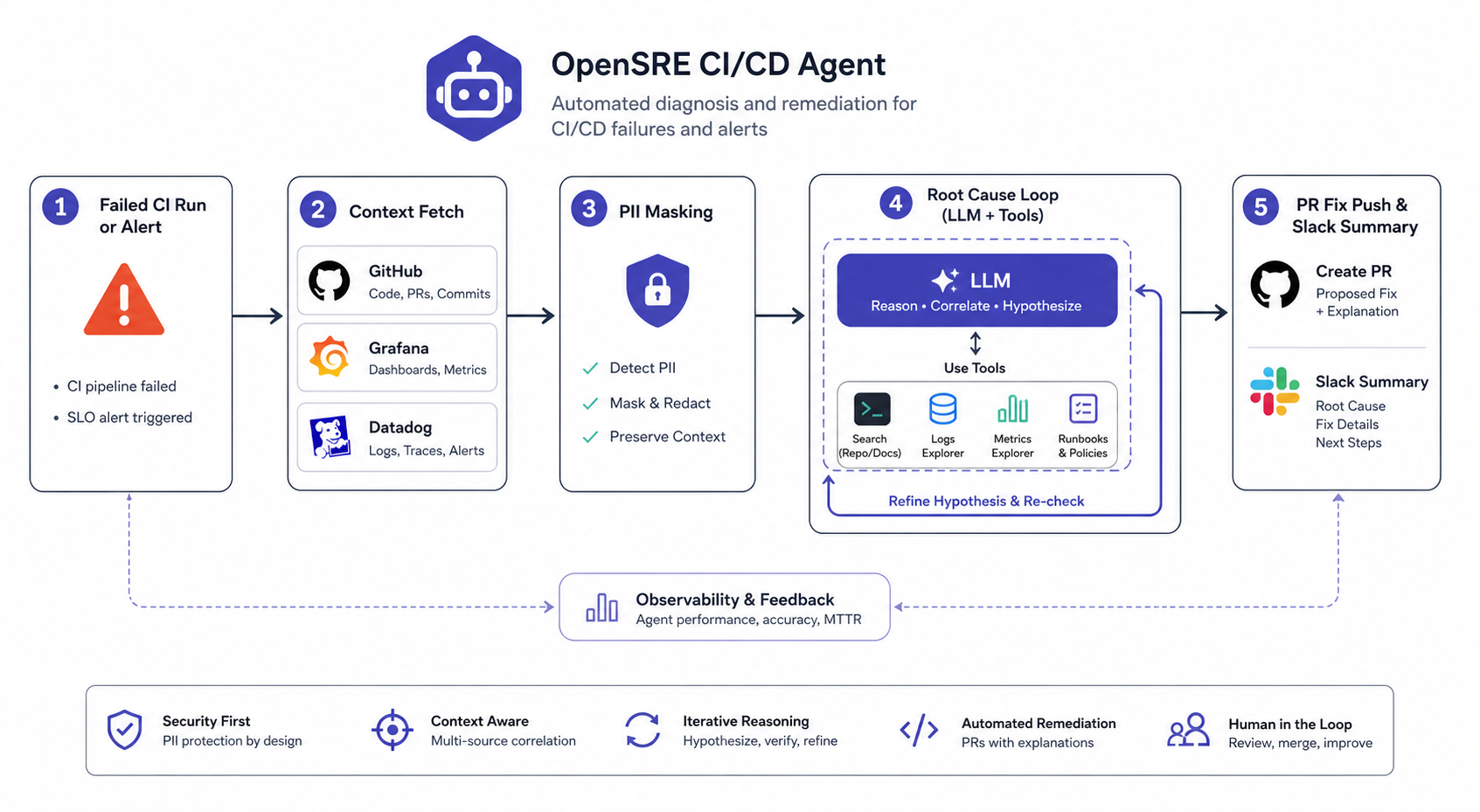
According to the official README, every investigation follows six steps:
- Fetch: Pulls failing checks, CI logs, recent commits, deploys, and correlated metrics or traces.
- Mask: Optionally redacts sensitive identifiers before calling external LLMs.
- Reason: Runs a tool-calling loop across connected systems to test hypotheses and isolate CI vs. code causes.
- Answer: Responds with links to concrete log and commit evidence.
- Fix: Pushes a proposed patch to the PR branch for review, or executes approved remediation steps.
- Post: Delivers a concise summary to Slack, PagerDuty, or Telegram.
Q. Which tools and LLM providers are supported out of the box? The README lists 60+ integrations: Anthropic, OpenAI, OpenAI Codex, Google Gemini, Ollama, and Bedrock for models; Grafana (Loki, Mimir, Tempo), Datadog, Sentry, CloudWatch, and New Relic for observability; Kubernetes, AWS, Azure, ArgoCD, and Helm for infrastructure; and GitHub, GitLab, Bitbucket, and Jenkins for CI/repos. Notion, Teams, Confluence, and Linear are listed on the roadmap.
Installation and three execution modes (CLI · Headless · Python API)
You can start interactively in a terminal or embed headless turns directly inside CI jobs.
Install on macOS or Linux with the official script (a PowerShell installer is also provided for Windows):
curl -fsSL https://install.opensre.com | bash -s -- -gh
opensre
OpenSRE exposes three runtime surfaces:
- Interactive shell (
opensre): A TTY REPL for natural-language incident triage with slash commands such as/status,/cost,/sessions, and/integrations verify. - Headless CLI (
opensre ask "..."): Runs a single non-interactive turn for scripts and CI pipelines. - Python API (
start_embedded_session): Drives the agent in-process from existing Python automation tools.
For team deployments, you can run the included Dockerfile on Railway, ECS, or Vercel, deploy a Telegram gateway AMI via make deploy-gateway, and add a Postgres DATABASE_URL only when shared gateway state is needed.
Public Alpha caveats, security, and telemetry
Even with an Apache-2.0 license, treat OpenSRE as a PR review assistant while it remains in Public Alpha.
- Public Alpha stability: The maintainers explicitly note that core workflows are usable for exploration, while APIs and integration contracts may continue to evolve.
- Opt-out telemetry: First-party product analytics and Sentry error reporting are enabled by default. Disable them in strict environments with
export OPENSRE_NO_TELEMETRY=1. - Keep humans in the merge loop: Let the agent investigate and open draft fixes, while engineers retain final merge approval. If you want a structured browser review layer around agent plans and diffs, see our Plannotator guide or CLI-Anything guide.
Toris's take
For solo developers and small teams: Start with opensre ask or GitHub integration strictly for red-build root-cause summaries and draft PR fixes, rather than full auto-remediation. It saves the most time when a build breaks late at night and you do not want to dig through raw runner logs from scratch.
For larger engineering teams: If your stack already runs on Grafana, Datadog, or Sentry with Slack alerts, self-hosting the Dockerfile with your own LLM keys, PII masking enabled, and OPENSRE_NO_TELEMETRY=1 makes for a practical staging pilot.
Sources
Advertisement